
Advocates say veterans may face IBM rates 6–19 times higher than civilians, a broad estimate since cases aren’t formally tracked. But advocates say trend is clear.
GAINESVILLE, Ga. — A group of veterans diagnosed with a rare and debilitating disease say they’re in a race against time—and they’re speaking out while they still can.
They’re asking the Department of Veterans Affairs to automatically grant disability benefits for inclusion body myositis, or IBM, a rare, progressive muscle disease that can eventually leave patients unable to move or speak.
For Navy veteran William “Augie” DeAugustinis, the fight has been long—and personal.

Before the wheelchair, Augie spent years in the cockpit. He joined the Navy while still in college, eventually earning his wings and flying the P-3 Orion, a four-engine aircraft used for anti-submarine warfare during the Cold War.
After training in Pensacola, Corpus Christi, and Maryland, he was deployed multiple times overseas—including two tours in Iceland and another in Sicily.
“I had always wanted to fly,” he said. “It was an exciting mission.”
That mission often meant flying low over the North Atlantic, tracking Soviet submarines in harsh conditions—sometimes just 200 feet above rough seas in winter.
But much of his time wasn’t just in the air.
“Our offices were inside a hangar,” Augie said. “There were a lot of exposures to solvents, degreaser and jet fuel.”
On the flight line, he says, the exposure could be even worse.
“Sometimes I went on a ten-hour mission with my sleeve soaked in deicing fluid,” he said.
At the time, he didn’t think twice.
“We were in our 20s—we thought we were bulletproof.”
Decades later, he believes those exposures may have played a role in his diagnosis.
“I quickly started having problems with my legs,” he said. “It’s just a straight line progression to a life in a wheelchair.”

It took five doctors and more than a year of testing to finally diagnose him with IBM—a rare, degenerative muscle disease with no cure. Over time, it can take away control of the arms, the ability to swallow, and even affect breathing.
“It’s 100% disability,” he said.
Augie and other veterans diagnosed with the disease call it ALS in slow motion. In their early stages, the illnesses can be confused with each other.
ALS, amyotrophic lateral sclerosis, better known as Lou Gehrig’s disease, is a neurodegenerative disease, whereas IBM has historically been considered an inflammatory muscle disease.
The Myositis Association’s description of the disease on its website, offers a snapshot of how more research is needed to truly understand it:
“There is currently some debate among myositis experts about whether or not inclusion body myositis is actually an inflammatory disease. Inflammatory cells are present in muscle tissue from those with inclusion body myositis, especially earlier in the disease process, but their role in causing muscle weakness is unclear. Anti-cN1A autoantibodies have also been found in some people with inclusion body myositis, supporting an immune-mediated mechanism of inclusion body myositis.
While the presence of inflammatory cells in muscle tissue is a common feature across many myositis subtypes, including inclusion body myositis, what sets inclusion body myositis apart is the presence of abnormal protein accumulations and tiny empty spaces called vacuoles within the muscle fibers. Both protein accumulations and vacuolar changes reflect a degenerative component of muscle damage and are considered potential alternative primary mechanisms in inclusion body myositis. This component may be the main reason that the disease does not respond to treatment with anti-inflammatory medications.”
“The complex diseases like IBM and ALS clearly have an environmental trigger, and we know veterans have many environmental exposures that us civilians do not have,” said Dr. Thomas Lloyd, chair of neurology at Baylor College of Medicine, who started researching IBM while on a neuromuscular fellowship focused on ALS.
“We think it’s probably triggered by the immune system going haywire,” he explained.
Dr. Lloyd says IBM usually starts in late adulthood, over the age of 45 and is more common in men. While Augie’s disease impacted his legs first, it usually begins with intense inflammation and degeneration of muscle cells in the hands.
Lloyd says his research, as well as that of researchers at UNC Chapel Hill, has shown a similar buildup of the same protein, causing problems for patients with both ALS and IBM. Each wrote letters to the VA in support of several veterans like Augie, as they fought for service-related disability benefits.
Because of IBM’s slow progression, diagnosis is often delayed or misdiagnosed for years. It is eventually confirmed by muscle biopsy.
Some researchers, like Dr. Lloyd, say IBM and ALS could be the body’s response to similar exposures, just with different outcomes.
Augie believes he’s seen that theory play out in real life. A fellow service member in Iceland who flew similar missions and was later diagnosed with ALS, while he lives with IBM.
The diagnosis changes everything.
William “Augie” DeAugustinis
While veterans with ALS receive immediate access to disability benefits, veterans with IBM must prove their illness is tied to their service—a process that can take years.
In Augie’s case, it took more than a decade of denials and appeals.
“Given everything we know now about what causes ALS, what ALS looks like from a molecular and genetic level, then I feel strongly that our patients with IBM, who are veterans, really deserve those same benefits as ALS patients,” said Dr. Lloyd.
“The real problem is the benefits side,” said Augie, referring to the Veterans Benefits Administration, which handles disability claims.
Even after approval, the process can remain difficult. Without a specific diagnostic code for IBM, some veterans are evaluated for entirely different conditions—leading to repeated exams, delays, and confusion.
“They need the benefits, not just the compensation, but medical care, home modifications, vehicle adaptations,” said attorney Ursula Mecabe, who has represented nearly 80 veterans with IBM. “And they’re getting buried in paperwork while their diseases are progressing.”
Depending on the study and how you do the math, advocates believe the number of veterans diagnosed with IBM may be anywhere from 6 to 19 times higher than the general population. It’s a wide range, because the medical community doesn’t formally track IBM cases. That’s left analysis to small case studies, open records requests, and voluntarily reported data.
That’s why he and other veterans are pushing for IBM to be treated the same way as ALS —as a “presumptive” condition, meaning it would automatically be considered service-connected.

Right now, IBM is being reviewed by the National Academies of Sciences, Engineering, and Medicine (often referred to as “the National Academies”) as part of a broader study examining veteran health and military exposures.
But Hill and Ponton, a veterans disability law firm that has represented IBM clients like Augie, have already commissioned their own report about the disease.
In a written statement, VA press secretary Quinn Slaven said:
“VA recognized ALS as a presumptive condition based on evidence showing a possible association between ALS and military service. Veterans are 1.5 times more likely to develop ALS than the general population.
“While no similar association has been identified for inclusion body myositis (IBM), VA continues to investigate this condition and asked the National Academies this year to conduct a new, comprehensive study on IBM.
“VA continues to decide disability benefits for IBM on a case-by-case basis. The lack of a diagnostic code for IBM in no way hinders VA’s ability to make decisions regarding service connection.”
The VA took public comments on the study, which will also include a review of the scientific literature on seven other neurodegenerative conditions. That deadline for written comments ended in mid-April, but there will be a virtual listening session on Thursday, May 14, 2026, from 1-3 PM EST. You can register by clicking here. Those who want to speak or listen to the session must register by April 30.
Augie believes there’s enough evidence to make that decision now. He says this fight is no longer just about his own benefits—it’s about changing the system for others.
“It’s a work of love for us,” Augie said. “We don’t want the people coming up behind us to go through 10, 12 years of frustration.”
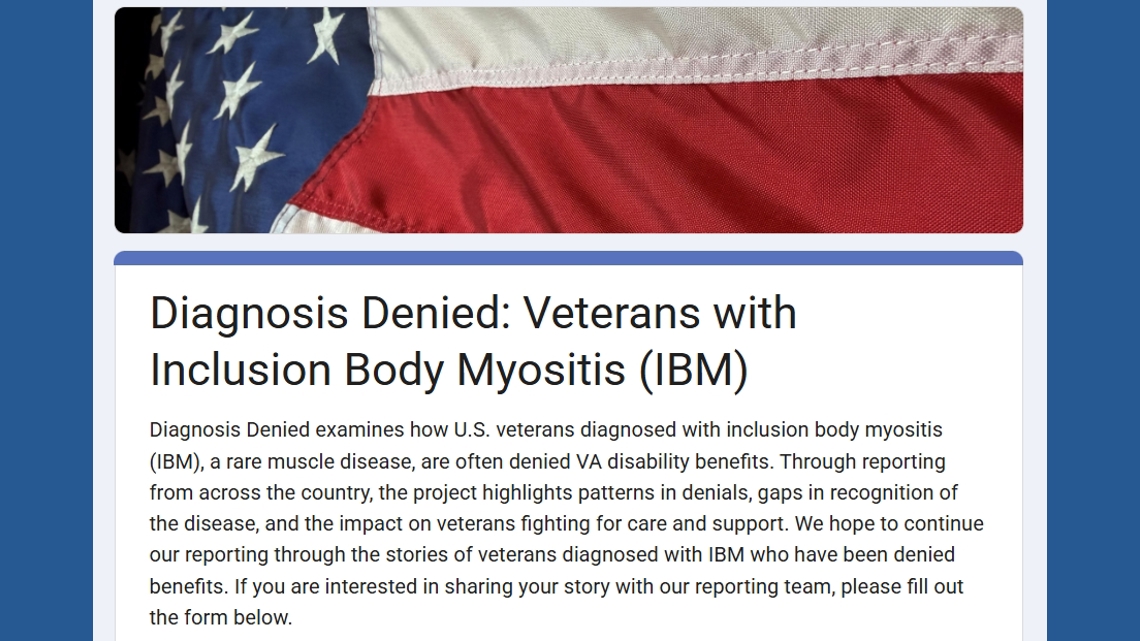
If you or someone you know served in the U.S. military and was diagnosed with IBM, the reporting team wants to hear from you. Please share their story by filling out the Google form.
***
EDITORS’ NOTE: 11Alive Investigates is part of a national project to raise awareness about IBM and better understand why veterans believe the disease should be service-connected. The report will be available on 11Alive+ starting May 11th.
Our team also contacted all of Georgia’s Congressional delegation about Augie’s story and the overall IBM project. So far, three have responded, including Rep. Rich McCormick, who sat down with 11Alive Senior Investigative Reporter, Rebecca Lindstrom, to share his perspectives on the issue.