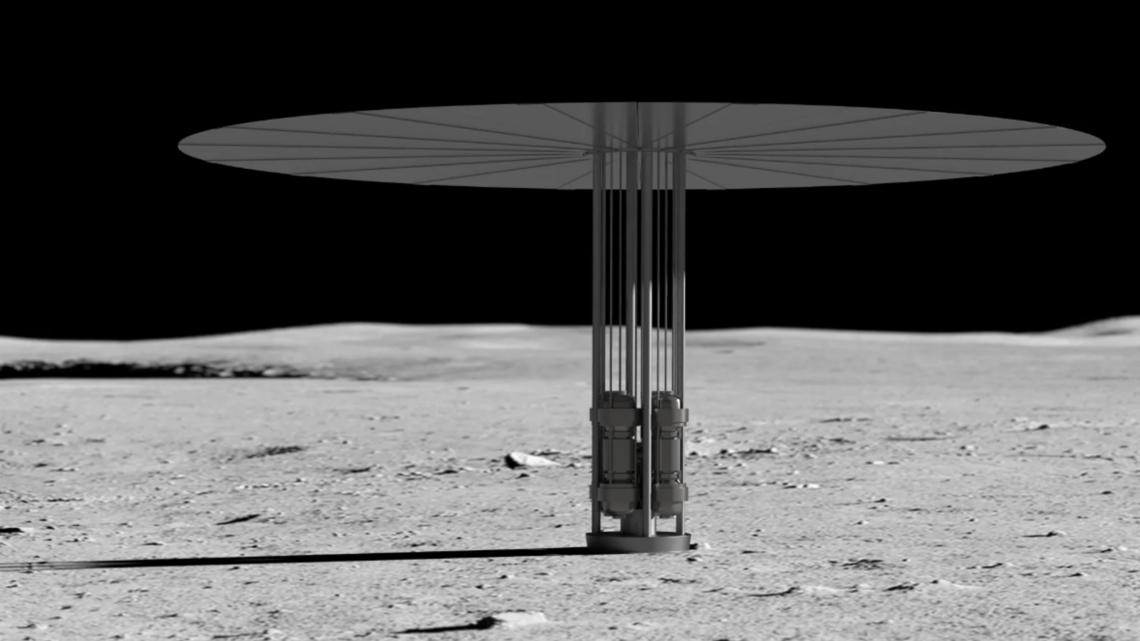
The reactors will be used to support NASA’s moon research and future missions to Mars, according to the announcement Tuesday.
WASHINGTON, D.C., USA — NASA and the U.S. Department of Energy are on track to build and deploy nuclear reactors on the moon in the next four years, according to an announcement from the departments on Tuesday.
Officials signed an agreement between the agencies that renewed their commitment to deploying the power systems on Earth’s celestial neighbor, according to a news release from the energy department. The reactors will specifically be used to fuel NASA’s research on the moon and future missions to Mars.
“Achieving this future requires harnessing nuclear power,” said NASA Administrator Jared Isaacman in the news release. “This agreement enables closer collaboration between NASA and the Department of Energy to deliver the capabilities necessary to usher in the Golden Age of space exploration and discovery.”
The reactors would be nuclear fission surface power systems. They would use a uranium reactor core the size of a paper towel roll to produce enough power to run several average households continuously for at least 10 years, NASA said during a 2018 demonstration. Officials said the power system is ideal for the moon due to the limitations of solar power, since lunar nights are equivalent to 14 days on Earth.
NASA ended its initial phase of the Fission Surface Power Project in 2024 to develop initial designs for the technology. The agency’s target date for delivering a reactor to the launch pad was the early 2030s.
While energy supplies are developed in space, power grids in the United States are facing potential shortfalls in the near future due to the spread of hyperscale data centers for artificial intelligence.
The nation’s largest power grid operator, PJM Interconnection, spans 13 states and serves about 67 million people. The grid would face power shortages due to data centers as early as 2027 unless it significantly increases power supplies, officials said in December. It’s the first time in history that the operators have failed to procure enough supply to meet expected energy demands.
Data centers are also driving energy shortfall alarms for the Midcontinent Independent System Operator, which serves 45 million people in 15 states. Current electricity load forecasts estimate energy shortfalls will begin around 2031.
Data centers have driven residents’ electricity bills to become increasingly unaffordable. Ameren, the utility that serves the majority of Illinois and Missouri, paid roughly $30 per megawatt day to purchase electricity from the Midcontinent Independent System Operator in 2024. In 2025, that cost has skyrocketed to $666.50.